Subscribe to Newsletter
 Donate
 Shop
Shop 61
61






By Jan Freiwald, Reef Check Executive Director
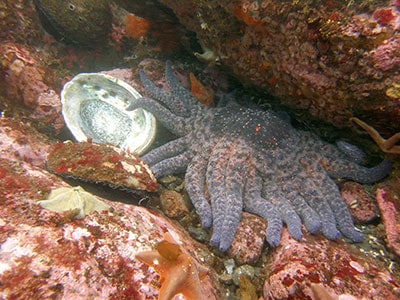
Over a decade ago, sea stars along the West Coast began disappearing almost overnight. At the time, in 2013, Reef Check volunteers noticed the alarming changes when they reported sick and dying sea stars at 25 survey sites stretching from Sonoma County to the Channel Islands and San Diego. The species with the most devastating losses was the sunflower sea star—the world’s largest sea star—which has been all but absent from California waters ever since. Over the following years, we have observed many of the consequences of this loss of what was once one of the major invertebrate predators in the kelp forest, including widespread urchin barrens and the continued decline of kelp forest in many areas along the coast. These changes in the kelp forest ecosystem were the beginning of a widespread die-off of red abalone in Northern California and the closure of the last recreational abalone fishery in the state, as well as the declaration of a fisheries disaster for the red sea urchin fishery in Northern California.
The cause of this mysterious illness, Sea Star Wasting Disease, was unknown for years. Divers watched as stars developed lesions, lost arms, and melted away, but no one could say for certain what was causing it. For years, scientists searched for the cause, considering everything from warming waters to viruses.
Now, thanks to research led by Melanie Prentice and Alyssa Gehman, of the Hakai Institute in British Columbia, Canada and their collaborators published in Nature Ecology & Evolution, the mystery has been solved. A bacterium, Vibrio pectenicida, is responsible for the wasting disease. Through careful experiments, the use of genetic datasets, and field observations, they identified the bacterium causing the disease symptoms. This breakthrough resolves one of the most enduring mysteries in one of the largest marine epidemics ever observed and this long-awaited discovery marks a major step toward understanding—and hopefully reversing—the decline of these important predators.
While the sunflower sea star was listed as critically endangered in 2020 by the IUCN, there are signs of hope. In recent months, a handful of sunflower sea stars have been spotted again along California’s Sonoma County coast. Reef Check staff joined other researchers in documenting these sightings, collecting data, and celebrating the chance to learn from these rare observations.